MLOps Lifecycle
Updated May 12, 2023 ·
Overview
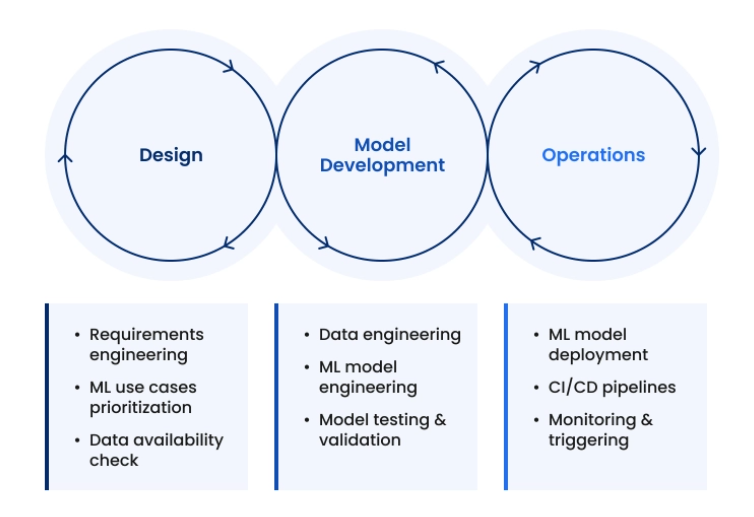
MLOps follows a structured process to turn machine learning ideas into real-world solutions.
- Design: Define goals, assess data, and set success metrics.
- Development: Train, test, and refine models.
- Deployment: Integrate models, monitor performance, and update as needed.
A structured lifecycle presents a clear roadmap which helps plan each stage of execution and ensures the right people and tools are involved at the right time.
Design Phase
This phase sets the foundation by defining goals and assessing feasibility.
-
Define the Problem
- Identify business needs and success criteria.
- Engage stakeholders to ensure project alignment.
-
Prepare Data
- Collect and clean high-quality data.
- Establish key metrics for evaluation.
Development Phase
The model is built, tested, and improved.
-
Experiment & Train
- Test different algorithms and parameters.
- Train multiple models to compare performance.
-
Refine & Optimize
- Evaluate results and fine-tune the model.
- Ensure the model meets defined success criteria.
Deployment Phase
The model is integrated into a live system and monitored.
-
Deploy & Scale
- Package the model as a microservice or API.
- Ensure smooth integration with existing systems.
-
Monitor & Maintain
- Track performance and detect issues like data drift.
- Update the model as needed to maintain accuracy.
Continuous Improvement
MLOps is an ongoing process, not a one-time task.
-
Evaluate Regularly
- Assess if the model is still delivering value.
- Make adjustments based on real-world feedback.
-
Iterate & Improve
- Refine models using new data and better techniques.
- Adapt strategies to meet evolving business needs.