Building the API
Exposing the Model
To make our model accessible, we expose it through an API (Application Programming Interface). APIs let applications communicate, just like user interfaces let humans interact with software.
- Server – Hosts the model and handles requests
- Client – Sends data to the server and receives predictions
- API Types – REST, RPC, SOAP, and others
APIs allow clients to run procedures (like sentiment analysis) or access remote data (like news articles).
API Example
Below is a sample API for a navigation app that estimates arrival time.
- Takes velocity and distance as input
- Runs them through the model
- Returns estimated arrival time
A simple API using FastAPI in Python:
from fastapi import FastAPI

app = FastAPI()

@app.get("/estimate")
def estimate_time(velocity: float, distance: float):
    if velocity <= 0 or distance <= 0:
        return {"error": "Velocity and distance must be positive numbers"}
    time = distance / velocity
    return {"estimated_time": round(time, 2)}
Example request:
curl "http://127.0.0.1:8000/estimate?velocity=60&distance=120"
Expected response:
{"estimated_time": 2.0}
Input Validation
To prevent errors, we validate input data before processing it.
- Ensure required fields – Check for missing inputs
- Verify data types – Ensure numbers are used where expected
- Reject invalid values – Prevent negative or zero values
If a client provides invalid input, the API should return a clear error message.
Output Validation
We also validate the model’s output to prevent unexpected behavior.
- Check for logical errors – Example: No negative arrival times
- Format responses properly – Ensure consistency
- Provide error messages – Help clients understand failures
This ensures that clients always receive valid and reliable responses.
Request and Response Models
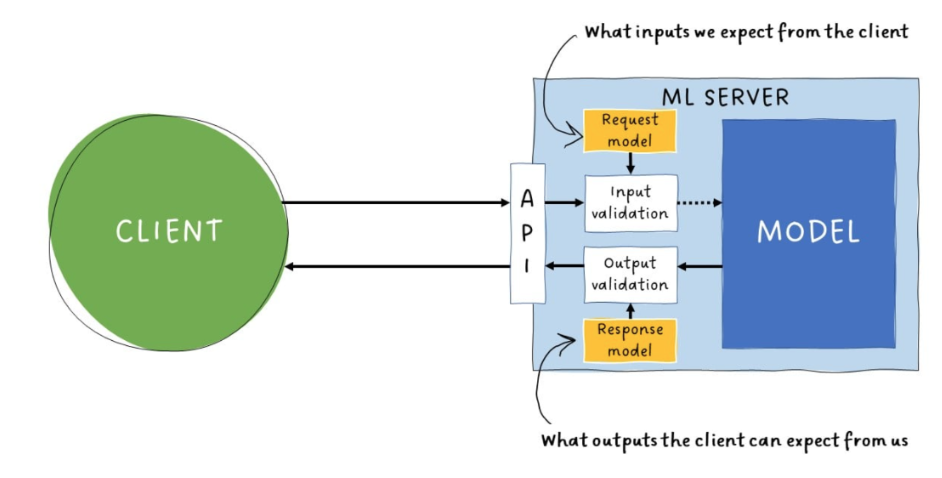
To enforce both the input and output validations, we need to define request and response models.
- Request model – Specifies expected input fields, types, and constraints
- Response model – Ensures structured, consistent output
These models help standardize communication between clients and the API.
Security and Rate Limiting
To protect our API, we restrict access and limit requests. The following measures ensure stability and prevent overuse.
- Authentication – Only allow authorized users
- Rate limiting/Throttling – Control requests made to prevent abuse
FastAPI is a great tool for building APIs efficiently which provides built-in validation, security, and documentation features.