IP Addressing
Overview
IP addressing is used to assign unique identifiers to devices on a network, allowing them to communicate with each other. Each IP address consists of a set of numbers that identify both the network and the specific device (host) on that network.
- 32-bit numbers, usually represented in dotted decimal format
- 128-bit, designed to accommodate more devices with a larger address space
- Used for routing data packets to their correct destination across networks
Dotted Quad Notation
Dotted quad notation is a way of representing IPv4 addresses as four decimal numbers separated by periods, each representing 8 bits of the address. For example, the IP address 192.168.1.10 is written in dotted quad notation.
192.168- network address- 1.10 - host address
Note: The division between the network and host address can vary, depending on the network's configuration.
Source and Destination
Source and destination IP addresses indicate where a packet is coming from and where it is going. These addresses guide the routing of data across networks.
- They play a crucial role in directing traffic on the internet
- The roles can be interchanged depending on the direction of communication
IPv6
Also called IP next generation (IPng), IPv6 is the most recent version of the Internet Protocol, designed to replace IPv4. It provides a vastly larger address space to accommodate the growing number of internet-connected devices.
- IPv6 addresses are 128-bit, represented as eight groups of four hexadecimal digits
- No need for Network Address Translation (NAT)
- IPv6 provides unique address for each device
- It includes built-in security features and improved routing efficiency
An example of an IPv6 address is:
2001:0db8:85a3:0000:0000:8a2e:0370:7334
This address is divided into eight groups of four hexadecimal digits, separated by colons. Each group represents 16 bits of the 128-bit IPv6 address.
For simplicity, leading zeros in each group can be omitted, so the address can also be written as:
2001:db8:85a3::8a2e:370:7334
The double colon (::) represents a consecutive group of zeroes that can be compressed to save space.
Types of IP Addresses
Public IP Address
Public IP addresses are globally unique and used for communication over the internet.
- Assigned by ISPs and required for accessing the internet.
- Can be static (permanent) or dynamic (temporary).
- Exposes devices directly to the internet, requiring robust security measures.
Private IP Addresses
Private IP addresses are used within private networks, not routable on the internet.
- Assigned to devices within a local network (e.g., home or office).
- Conserve public IP addresses, allows multiple devices to share one public IP via NAT.
- Commonly used in LANs to facilitate communication within the network.
Private IP Addresses have the following types:
| Class | IP Range | Usage | Number of IP Addresses |
|---|---|---|---|
| Class A | 10.0.0.0 - 10.255.255.255 | Large networks | Over 16 million |
| Class B | 172.16.0.0 - 172.31.255.255 | Medium-sized networks | Over 1 million |
| Class C | 192.168.0.0 - 192.168.255.255 | Small networks (e.g., home networks) | Up to 65,536 |
| Class D | 224.0.0.0 - 239.255.255.255 | Multicast groups (e.g., streaming, video conferencing) | N/A |
Subnetting
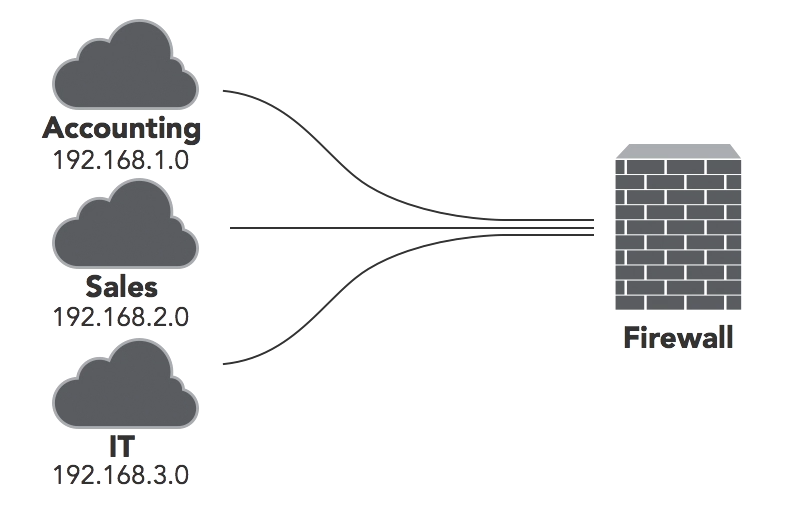
Subnetting divides a large network into smaller, more manageable sub-networks (subnets).
- Helps in managing IP address allocation within a network.
- Enhances security by isolating network segments.
- Optimizes network performance by reducing broadcast traffic.
For example, subnetting can be used to divide departments within an organization into separate, isolated networks.
Subnet Mask Notation
A subnet mask is used to define which portion of an IP address is the network part and which part is the host part. It plays a crucial role in dividing networks into subnets.
- Typically represented in dotted decimal format, like
255.255.255.0. - Helps in determining the size of a subnet and the number of possible hosts.
- Essential for network routing and segmentation.
Example:
- IP Address:
192.168.1.10 - Subnet Mask:
255.255.255.0
Slash Notation
Slash notation, or CIDR (Classless Inter-Domain Routing) notation, represents the subnet mask by specifying the number of bits used for the network portion.
- Denoted as a suffix to the IP address, such as
/24for a subnet mask of255.255.255.0. - Simplifies the representation of subnet masks.
- Widely used in modern networking for efficient IP address allocation.
Example:
- IP Address:
192.168.1.10/24